So, i have a house in Haliburton Ontario. Historically we drop a cool $3k a year on propane.
Last year we installed a Mitsubishi hyper heat ductless system.
We used zero gas this year. Read it again, zero.
It’s lakefront, very remote, and the largest electricity bill i got was around $450 for a month and then they dropped back to something more like $250. The savings are huge, I’m no longer stressed about running out of gas…and the heat pump performed well beyond its advertised specifications. We had a few -25C days and it was humming hard, but the house stayed a comfortable 20C inside. The house is around 3000sqft and we didn’t even get the largest unit, i can’t stress enough that they actually operate better than advertised.
We would run a fire from time to time but we did that with propane too, it’s mostly ornamental.
It's worth running the numbers based on your particular utility costs, though. In our case, with somewhat expensive gas and very expensive electricity, the heat pump would have cost quite a bit more to run: https://www.jefftk.com/p/running-the-numbers-on-a-heat-pump
With an air-to-water system like a Vaillant aroTHERM plus you could possibly achieve your break-even COP of 4.5 (the 12kW unit costs about US$7,200 in Europe, although from what I hear about the US heat pump market you'd probably pay like $20K for the unit alone for some reason).
(Also, how do you guys function with those strange units? Therms, BTU/hr, etc. - all so confusing. Surely electrification and the shift to heat pumps could be a convenient excuse to start using watts (kW in this magnitude) for heat and joules (usually MJ) for gas!)
I do think an air-to-water could make sense for us, though it wouldn't be able to handle the coldest days because our radiators aren't sized to keep the house warm at the lower water temperatures it puts out. The main problem is figuring out who can install one, since it's a pretty unusual product here.
(You get used to whatever units you're using, and the US units make some calculations easier and others harder. If I could switch it all over to the SI system without massive transition costs I would, though!)
You might be surprised at how well cast iron rads can provide comfort at low outside air temps and low flow temps. (I'm in neighboring Cambridge in an old, poorly/non-insulated house.)
https://news.ycombinator.com/item?id=39144329 has a bit of details on the experiment I ran back in 2022 to prove 135°F flow would work for us. (If you have a condensing boiler, you can run this experiment safely; if you have a non-condensing boiler, you can run it, but not for very long as you'll be damaging the flue and boiler with condensation at these lower temps.)
My outdoor reset curve (sadly, on a gas combi boiler because of the "pretty unusual product" factors) is now set to 105°F at 55°F OAT and 154°F at 0°F OAT (which is lower than the design temperature here, but it gave me more resolution to tweak the line to fit the loss just right; it's spot-on on the lower end, with the system running 22-24 hours per day when it's cold out and stays that way up until around freezing, where the utilization falls off).
Matching the gain to the loss quite closely has resulted in a house that's the most comfortable since we moved in in 2007 and gas bills with the combi went down about 46% (versus a 1990s oil-to-gas conversion of a 1950s boiler, so not a realistic comparison for anything that wasn't built by General Motors [not a typo]).
We have one loop with cast iron radiators, but the other two loops are modern baseboard. When we installed a condensing boiler in 2015 I needed to adjust the outdoor reset curve up so the loop that serves the first floor wouldn't leave it under temp on cold days.
Even our cast iron radiators are smaller than you might expect for the age of the house, because they were designed for water above its normal boiling point (using mercury pressure: https://www.jefftk.com/p/mercury-spill).
I also have one loop of modern baseboard. Fortunately, it's in the attic conversion where they did insulate the rafters while doing the conversion, so it works even at that lower temp. I did do something slightly unconventional in plumbing that zone in a primary/secondary and it gets the water from the boiler "first" and returns it to the primary loop ahead of the main zone which is all cast iron rads. That means the baseboard gets the hottest water possible and the full potential flow from the boiler if it "needs" it. In practice, that zone tends to only run 4-5 hours per day while the main zone is running 22-24 hours, so either what I did works really well and/or I didn't need to do it in the first place.
But, you've already discovered your reset curve with modern equipment, so you know the right answer for your place.
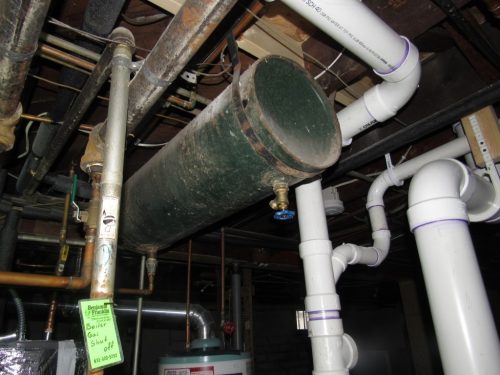
Thanks for the story on mercury pressurization! Fascinating. I learned a lot about our old house (originally gravity circulated as well, but near as I can tell, pressurized only to the typical 12-15 psi and with an in-ceiling green steel expansion tank: https://structuretech.com/wp-content/uploads/2020/03/Old-sch... )
(And of course, sorry to hear about your contamination inconvenience and expense!)
Jefftk I'm in the same boat -- what I'm going to have to do if I want to do the air to water heating is bring in a booster/combo unit that will boost the water temp to make the house the right temp. So I'm still tied to gas but much lower amounts - heat pump does the majority of the work and I still have protection on very low temp days.
Hmm. I wonder if adding an air-to-water pump to the existing loop, before the boiler, can be made to work? Perhaps with a microcontroller intermediating the thermostats on both to turn each on at the ideal time?
There are products that exist for that, though as always: maybe not in your market.
Over here they're called hybrid heat pumps and are quite popular. (At least with those that offer to sell them.) They're used in improving existing gas powered solutions. The heat pump takes most (or usually all) of the heating, while the existing gas heater provides hot water and can add peak heat if needed.
Can you point to some of those. I am curious at other options for my own heating operations but the landscape is difficult to navigate as a consumer and then you need to find people capable of helping out.
- Remeha, with the types Elga Ace, Mercuria, and Mercuria Ace
- Nefit/Bosch with Nefit EnviLine hybrid and Bosch Compress 7400i AW
- Vaillant aroTHERM plus/pro/split
There's also the Quatt Hybrid, which I haven't heard of before, but it looks nice. And according to their website it has a large market share.
100% agree. Our electricity costs are fairly low, and its a very low carbon source (mostly hydro electric + nuclear), so for us it makes a huge amount of sense. If you're in Alberta, where most of the electricity comes from coal...theres no logic in switching to electricity.
I'd argue that's politically motivated and very deliberate however...
Almost all coal plants in Alberta have been shut down and it's a small minority of net generation now. Natural gas has taken up most of the slack, but there's actually quite a lot of solar and wind generation in Alberta considering the politics (though that's likely to slow down now).
Ah i didn't realize the coal plants were retired! That's good to see. I was looking at the carbon impact per kwh in Alberta earlier in the year for a project I was working on, and was surprised how high it was. I guess other areas of the country just have a lot of other sources diluting the impact.
We got a heat pump installed alongside the gas system, since it's still working.
I would love it if there were a service or some code to look at 1) gas prices 2) electricity prices 3) how efficient the two systems are and switch back and forth depending. Like... if it's -10C out, run the gas. As it gets closer to 0C, switch over at some point.
If gas is flat out always cheaper, you could still put a cutoff point where you're willing to spend a bit more because it's better for the environment.
Depends where you are. Gas is certainly not cheaper for us. I did the math based on cost per KWH of fuel consumed v's the efficiency of the unit producing it. Natural gas would be slightly more expensive (marginal though...2% or so) but propane is around 3x more expensive, and with many people on oil the math is even worse.
In many regions electricity isn't as cheap as ours though, so that changes the game.
>Historically we drop a cool $3k a year on propane.
Similar to our situation, also in Canada; we cut our fuel bill by 3/4 after getting a heat pump. I still run the furnace on the coldest days, because it's hard to beat. But 9 days out of 10 the heat pump is all we need. The fact that it doubles as an AC unit (and is even more efficient) is gravy.
I also bought a heat pump hot water tank, and so far so good.
I live a few 100 km east of there and just had a heat pump installed last fall. I still have to spend $800 a year on wood but now my home is 20 C all day every day and I no longer have to break the ice on the dog's water bowl in the mornings. I still fire up the stoves to keep hydro costs down and so far the hydro bills haven't been particularly different from previous years when I had to use supplementary electric resistive heat. Then again, it's been a particularly mild winter with zero days below -30.
This winter was really mild. I was curious if we'd spend more or less, and honestly i wasn't super concerned. My napkin math suggested it would be comparable, but come with the benefit of reducing the risk we'd run out of gas. The propane truck cant make it up our road from late November early April, and last year we got down to around 20% remaining (which is around the point where the tank stops working due to there not being enough pressure).
Huge bonus that its been cheaper, and substantially...but I just love relaxing about the reduced risk of the house running out of fuel.
Did you consider putting up solar to counteract the additional electrical load? Sure it would take 7-10 years to pay off the solar asset but after that its free electricity and heating. Something I'm playing with but its a bit more difficult in the city.
Looks like it. I'd suggest anyone looking at a system like that install at least 2 separate outdoor units. That way if one breaks the other can still work - and most of the year it will be powerful enough to handle the whole house (some rooms will be a little uncomfortable but bearable)


Last year we installed a Mitsubishi hyper heat ductless system.
We used zero gas this year. Read it again, zero.
It’s lakefront, very remote, and the largest electricity bill i got was around $450 for a month and then they dropped back to something more like $250. The savings are huge, I’m no longer stressed about running out of gas…and the heat pump performed well beyond its advertised specifications. We had a few -25C days and it was humming hard, but the house stayed a comfortable 20C inside. The house is around 3000sqft and we didn’t even get the largest unit, i can’t stress enough that they actually operate better than advertised.
We would run a fire from time to time but we did that with propane too, it’s mostly ornamental.
https://photos.app.goo.gl/FCwLJQAtoG67g9y86
https://photos.app.goo.gl/TwiMaSAj9hGxYqby6
https://photos.app.goo.gl/gYVYvVEB3whLCv1dA
https://photos.app.goo.gl/49RcBdBuUZ2jVN3J7